British Council’s Allegedly Unauthorized Business Nears Rs 1 Billion, Nearly Rs 370 Million Sent Abroad

मंगलबार, १२ साउन २०८३
Kathmandu — British Council Services Nepal Private Limited, which has been providing language testing, training and educational services in Nepal, earned approximately Rs 934.6 million in a single fiscal year.
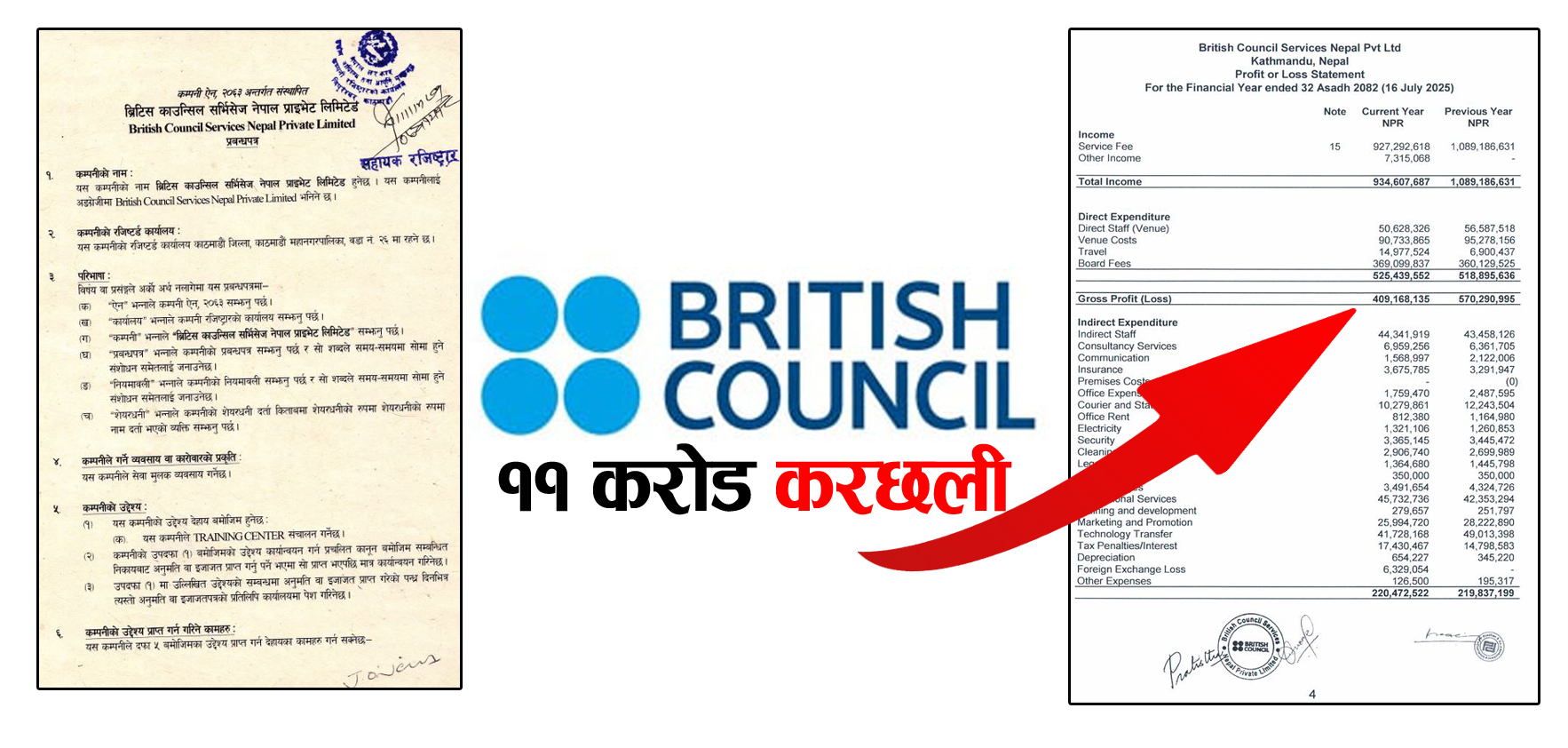
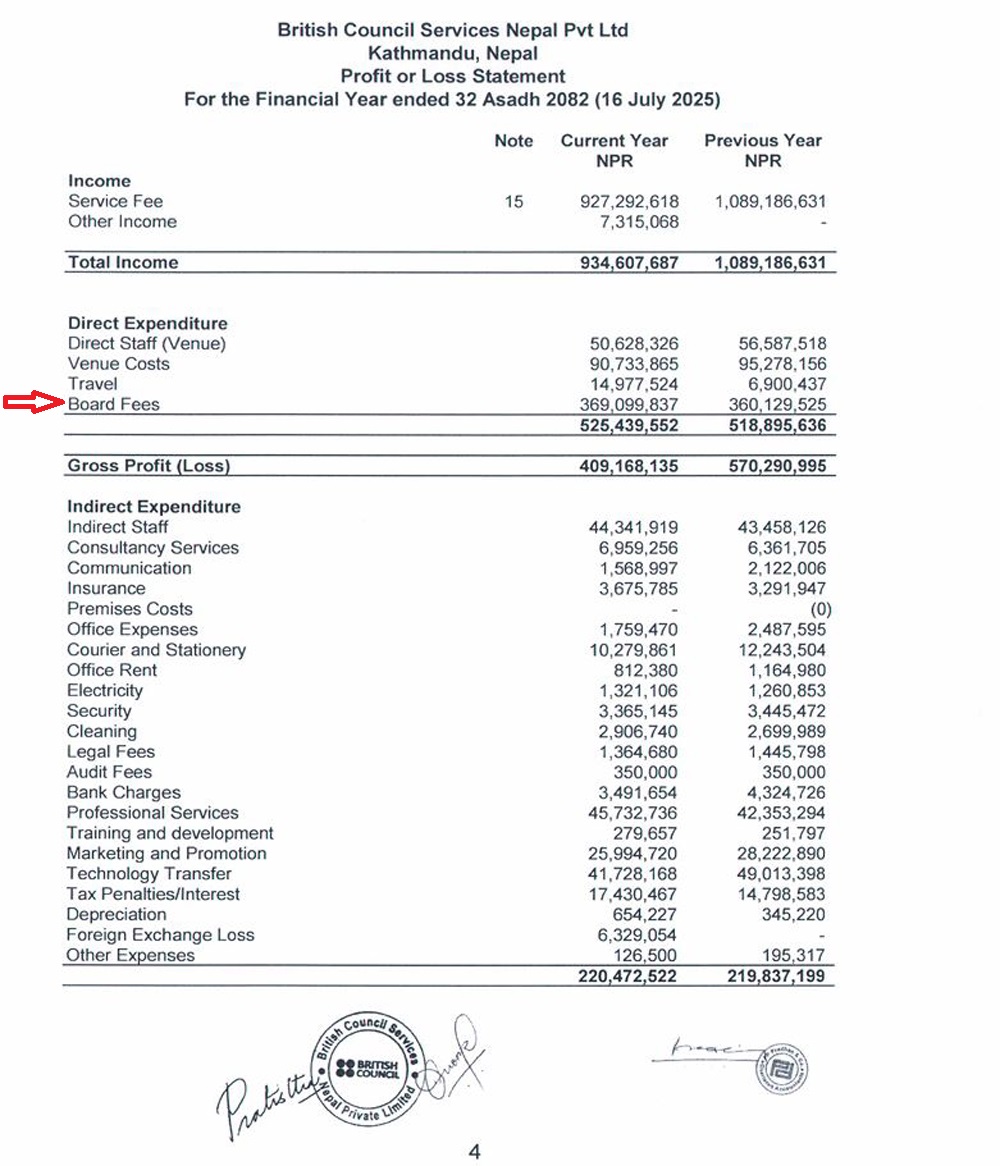
A review of the company’s audit report for fiscal year 2081/82 shows that it earned Rs 927,292,618 from service fees and Rs 7,315,068 from other sources. Its total income for the year stood at Rs 934,607,687.
The company’s largest source of revenue was paper-based IELTS, from which it collected Rs 554,759,945. It earned Rs 132,545,813 from computer-delivered IELTS, Rs 157,632,855 from Cambridge examinations and Rs 29,792,758 from ACCA. Additional revenue came from UKVI, Life Skills, the Foundation English Test, the Digital Library and other services.
Paper-based IELTS, previously the company’s main source of income, has now been discontinued. Students preparing to study abroad are now required to take the computer-delivered IELTS test.
Alongside its substantial income, the company has reported unusually high expenditure. The company, which allegedly operated without obtaining approval from the Ministry of Education and Sports, recorded Rs 369,099,837 under the heading “board fees.”
The amount is not shown as a dividend distributed to the company’s Nepal-based director. Rather, the financial statements describe it as a fee payable to the British Council in the United Kingdom. In the preceding fiscal year, the company had reported Rs 360,129,525 under the same heading.
Operating Without Regulatory Approval
Another serious issue concerns the regulatory approval required for the services being operated by the company.
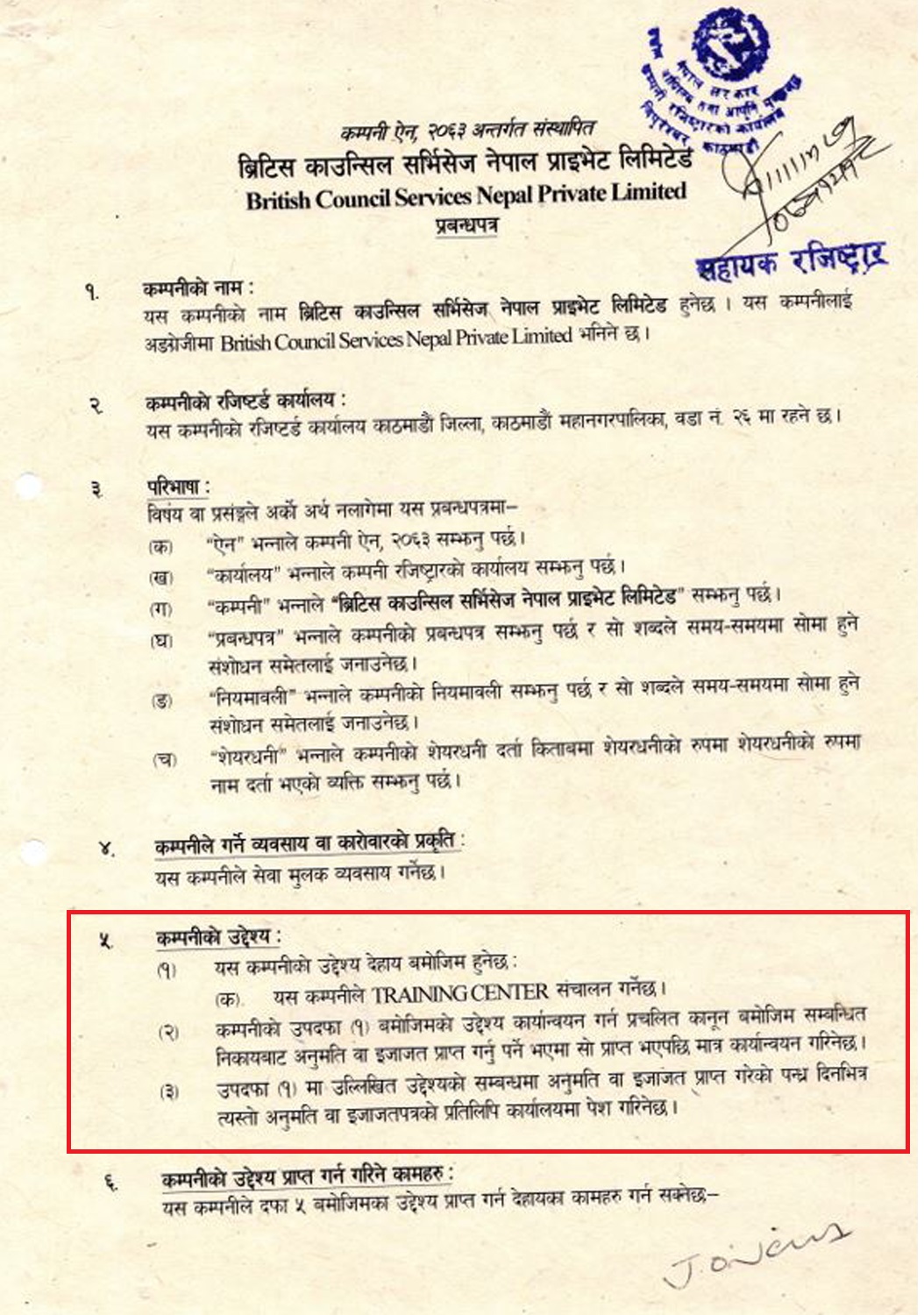
British Council Services Nepal was established on March 31, 2019, with a single stated objective. Clause 5(1) of its Memorandum of Association states that the company’s objective is to operate a “training centre.”
Clause 5(2) further provides that if permission or a licence from the relevant authority is required under prevailing law, the company may implement its objective only after obtaining such approval.
Institutions providing language teaching, preparatory classes and language-testing services are required to obtain approval from the Ministry of Education and Sports. The Educational Consultancy and Certification Section under the ministry registers and renews institutions authorized to provide such services. The ministry also publishes a list of institutions that have obtained approval and renewal.
However, as of the preparation of this report, British Council had allegedly neither obtained approval from the section nor submitted an application seeking permission to operate its services.
According to Shemant Koirala, a joint secretary of the Government of Nepal and head of the section, no language-testing institution other than IDP IELTS has received approval from the ministry.
Interestingly, Clause 5(3) of the company’s Memorandum of Association requires it to submit a copy of the relevant permission or licence to the Office of the Company Registrar within 15 days of receiving it.
Despite the company approaching eight years of operation, it has allegedly continued conducting transactions worth hundreds of millions of rupees without ministry approval. Questions have also been raised over the enormous amount reported under “board fees.”
Who Was Paid Rs 369,099,837?
The company’s Memorandum of Association does not name any individual as a director. Clause 13 provides that the company must have at least one director and that, until the first annual general meeting is held, the promoter shall appoint the director.
The company’s promoter and sole shareholder is BC Holdings (United Kingdom) Limited, a company registered in the UK. According to the Memorandum of Association, all 50,000 shares issued by the company are owned by BC Holdings.
At the time of incorporation, London-based Jim O’Neill signed the Memorandum of Association as an authorized representative of BC Holdings. However, the document does not clearly state whether he was merely a representative of the promoter or also a director of British Council Services Nepal. O’Neill, who lived in Nepal for a considerable period, has since returned to the UK.
In the audit report for fiscal year 2081/82, Pratistha Thapa Rayamajhi signed the financial statements as the company’s director, while Dinesh Koirala signed as company secretary. Based on the records available for that fiscal year, Rayamajhi is the director identified in the audit report.
The related-party disclosure in the audit report identifies the board of directors, senior management, the company secretary and shareholder BC Holdings as related parties. However, the report states that there were no related-party transactions among them.
The financial statements do not establish that the Rs 369,099,837 recorded as “board fees” was distributed to Pratistha Thapa Rayamajhi, Jim O’Neill or any other individual. According to the auditor’s observations, the amount represents a foreign-currency-denominated fee payable to the British Council in the United Kingdom.
Regulatory authorities must therefore investigate the agreement, rate and services on which the board fee was based, as well as whether the amount was actually transferred abroad or merely recorded as a payable liability.
More Than Rs 110.8 Million in Alleged Tax Evasion Through “Board Fees”
Of the company’s total income of Rs 934.6 million in fiscal year 2081/82, approximately Rs 369.1 million was recorded as board-fee expenditure. This represents around 39.5 percent of its total income.
The company’s total direct expenditure was approximately Rs 525.4 million, of which board fees alone accounted for around 70 percent. Tax and accounting professionals say that recording such a large amount under a single expenditure heading appears unusual and warrants scrutiny.
In the preceding fiscal year, the company had similarly recorded approximately Rs 360.1 million as board fees. The fact that almost the same substantial amount was shown as payable to the British Council in the UK for two consecutive years raises questions about the basis on which the fee was determined, the underlying agreement and the services or benefits received in return.
Board fees are generally determined based on meetings of a company’s board of directors. However, it remains unclear where and how frequently the board of this single-director company met, who attended the meetings and how the fee was calculated.
In Nepal, companies generally provide directors with a meeting allowance of up to Rs 25,000 per meeting, along with facilities covering telephone, communications, newspapers and fuel. Such facilities normally require approval from the company’s annual general meeting.
The company’s own audit report states that the auditor was unable to obtain sufficient appropriate evidence and that the financial statements had not been prepared in compliance with the applicable Nepal Financial Reporting Standards. Consequently, the auditor did not express an opinion on the financial statements. This further raises questions about the reliability and basis of the board-fee expenditure.
Recording the board fee as an expense reduces the company’s taxable profit by an equivalent amount. Accounting experts claim that, when the 25 percent corporate income-tax effect and an additional five percent tax allegedly applicable to the recipient are considered, the potential tax implication could exceed Rs 110.8 million.
If the entire Rs 369.1 million expenditure was accepted as deductible, its theoretical impact on taxable income and associated taxes could exceed Rs 110.8 million, according to this calculation. If the expense is subsequently found not to have been genuine, necessary or based on an arm’s-length value, tax authorities could have grounds to reassess millions of rupees in additional tax.
The Inland Revenue Department has said it will review British Council’s audit report and take an appropriate decision.
“Board fees cannot be paid outside the limits set by law. Arbitrarily claiming such fees could violate the Income Tax Act,” a department source said. “Please send us the documents in your possession. We will conduct further investigation and initiate action as required.”
The transfer-pricing provisions of the Income Tax Act require transactions between related entities to be conducted at market value. Tax authorities may reassess a transaction if an unreasonable price is found to have been used to reduce taxable income.
British Council has not responded to questions concerning the matter. An email containing several questions sent to British Council remained unanswered. Pratistha Thapa Rayamajhi, identified in the records as the company’s director, also declined to comment. She did not respond to questions sent through telephone and WhatsApp.
The company has also been accused of evading value-added tax worth tens of millions of rupees.